Understanding the Basics of Artificial Intelligence
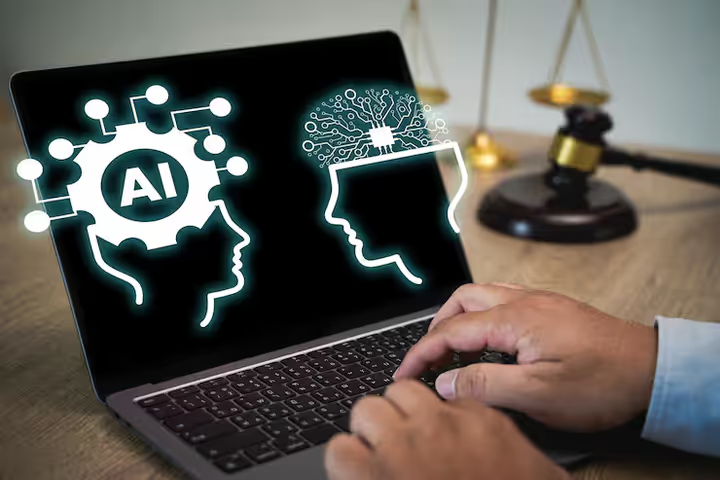
Artificial Intelligence (AI) empowers machines to perform tasks requiring human-like intelligence, such as learning, reasoning, and decision-making. From simple predictive text to advanced image recognition, AI is transforming everyday life and industries worldwide.
What is Artificial Intelligence?
At its core, AI is a branch of computer science dedicated to building systems that mimic human intelligence. These systems can perceive their environment, learn from data, recognize patterns, understand language, and make decisions autonomously.Unlike traditional software following rigid rules, AI adapts and improves over time.
Consider predictive text on your smartphone: it suggests the next word based on context, a basic form of AI. Even simple algorithms qualify as AI if they handle tasks typically needing human smarts, like problem-solving or speech recognition.
AI isn't about creating sentient robots—it's about practical tools that enhance efficiency. Today, most AI falls under **Artificial Narrow Intelligence (ANI)**, excelling at specific tasks like voice assistants or email filtering.
How Does AI Work?
AI relies on three pillars: data, algorithms, and computational power. Systems learn by processing vast datasets to identify patterns, rather than following explicit instructions.[1][4] This shift from rule-based programming to data-driven learning marks modern AI's power.
The process mirrors human learning but at scale. AI **learns** from examples, **predicts** outcomes, and **generates** new content like text or images.[1] For instance, training an AI to spot dogs involves feeding it thousands of labeled photos; it discerns features like fur or ears independently.
The Machine Learning Process
**Machine Learning (ML)**, AI's powerhouse subset, enables systems to improve from experience without reprogramming. Here's the step-by-step journey:
- Data Collection: Gather diverse, high-quality data—images, text, or numbers. Quality matters; biased data leads to flawed results.
- Pattern Recognition: Algorithms scan data for relationships, like linking purchase histories to recommendations.
- Model Training and Optimization: The model tweaks parameters iteratively, minimizing errors by comparing predictions to real outcomes.
- Testing and Deployment: Validate on unseen data, then deploy for real-world use, refining as needed.
Deep Learning, a ML advancement, uses **neural networks**—layered nodes inspired by the brain—for complex tasks like image recognition.
Key Branches of AI
AI encompasses specialized fields:
- Natural Language Processing (NLP): Handles human language, powering chatbots and translation. Large Language Models (LLMs) like those behind ChatGPT analyze text patterns to generate responses.
- Computer Vision: Interprets visuals, enabling facial recognition or self-driving cars.
- Deep Learning: Excels in unstructured data via multi-layered neural networks.
Types of AI: Narrow vs. General
AI splits into **Narrow AI (ANI)**—current reality, task-specific—and **General AI (AGI)**, a theoretical human-level intellect across domains. ANI powers tools like Siri; AGI remains a distant goal, capable of novel problem-solving without retraining.
Real-World Applications
AI revolutionizes sectors:
- Healthcare: Diagnoses diseases from scans faster than humans.
- Finance: Detects fraud via anomaly patterns.
- Transportation: Enables autonomous vehicles through vision and decision-making.
- Entertainment: Generates art, music, or personalized recommendations.
Daily examples include spam filters, virtual assistants, and navigation apps predicting traffic.
Ethical Considerations and Challenges
AI's rise brings responsibilities. **Bias** in training data can perpetuate inequalities; **transparency** is key to trust. Misuse risks, like deepfakes or job displacement, demand governance.
Oversight ensures fairness, privacy, and accountability. Diverse datasets and ethical frameworks mitigate issues, balancing innovation with societal good.
The Future of AI
AI promises automation, personalized medicine, and climate solutions, but requires careful stewardship. As capabilities grow toward AGI, collaboration between developers, policymakers, and society will shape a beneficial trajectory.
Understanding AI basics empowers everyone to engage with this transformative technology thoughtfully.