Industrial Automation: A Complete Guide to Modern Industrial Auto Systems
Industrial automation has become an important part of modern manufacturing, logistics, energy, and processing industries. It uses control systems, software, sensors, robotics, and industrial equipment to perform tasks with less manual intervention.
As businesses look for better productivity, consistent quality, workplace safety, and efficient resource utilization, industrial automation continues to develop across many sectors. This article explains the fundamentals, applications, benefits, technologies, costs, and future trends of industrial automation in a clear and educational way.
What Is Industrial Automation?
Industrial automation is the use of technology and control systems to operate industrial processes automatically or with limited human intervention.
A typical automated system can collect information through sensors, process that information using a controller, and then instruct machines or equipment to perform specific actions.
Industrial automation may include:
- Programmable logic controllers (PLCs)
- Industrial robots
- Sensors and measurement devices
- Motor control systems
- Human-machine interfaces (HMIs)
- Supervisory control and data acquisition (SCADA)
- Industrial networking
- Manufacturing software
- Machine vision systems
- Automated material-handling equipment
The level of automation can range from a single automated machine to an integrated production facility.
Why Is Industrial Automation Important?
Manufacturers and industrial organizations operate in environments where productivity, quality, safety, and operating costs are important considerations.
Automation can help organizations manage repetitive processes while providing better visibility into equipment and production activities.
Improved Production Efficiency
Automated equipment can perform repetitive operations at consistent speeds. This can help production facilities improve throughput and make better use of available equipment.
Consistent Product Quality
Automated inspection and control systems can measure production parameters continuously. When configured correctly, these systems can help identify deviations before they become larger quality problems.
Workplace Safety
Some industrial processes involve heat, chemicals, heavy materials, high-speed machinery, or other potentially hazardous conditions. Automation can allow machines to perform certain tasks while workers supervise, maintain, or manage the process from safer locations.
Better Operational Data
Modern automation systems can collect information about production rates, machine conditions, energy consumption, downtime, and other operational factors.
This data can support more informed maintenance and business decisions.
Main Types of Industrial Automation
Industrial automation is commonly divided into several categories based on how processes are controlled.
Fixed Automation
Fixed automation is designed for repetitive operations with relatively stable production requirements.
It is often used in high-volume manufacturing where the same sequence of operations is performed repeatedly.
Programmable Automation
Programmable automation allows equipment to be reconfigured for different products or production batches.
PLCs and industrial control software are commonly used in these systems.
Flexible Automation
Flexible automation is designed to accommodate product variations with relatively limited changes to the production system.
It can be useful for manufacturers producing multiple product configurations.
Integrated Automation
Integrated automation connects different machines, controllers, software systems, and data sources into a coordinated industrial environment.
This approach can provide centralized monitoring and improved visibility across production operations.
Key Components of an Industrial Automation System
An automated industrial system normally consists of several interconnected components.
Sensors
Sensors collect information from machines and processes. They can detect variables such as:
- Temperature
- Pressure
- Position
- Speed
- Flow
- Vibration
- Proximity
- Level
The collected information can be transmitted to controllers for analysis and action.
Programmable Logic Controllers
A PLC is an industrial computer designed to control machinery and processes.
The PLC receives input from sensors, processes programmed instructions, and sends output signals to devices such as motors, valves, actuators, and other equipment.
Human-Machine Interface
An HMI provides an interface through which operators can monitor and interact with industrial equipment.
A typical HMI may display production information, alarms, equipment status, and process parameters.
Industrial Robots
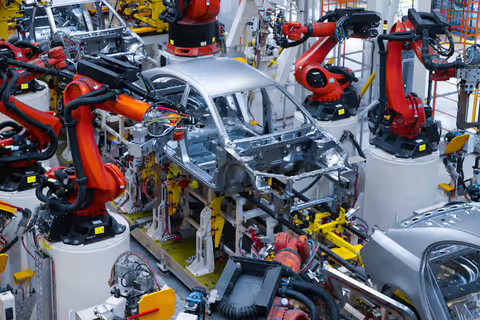
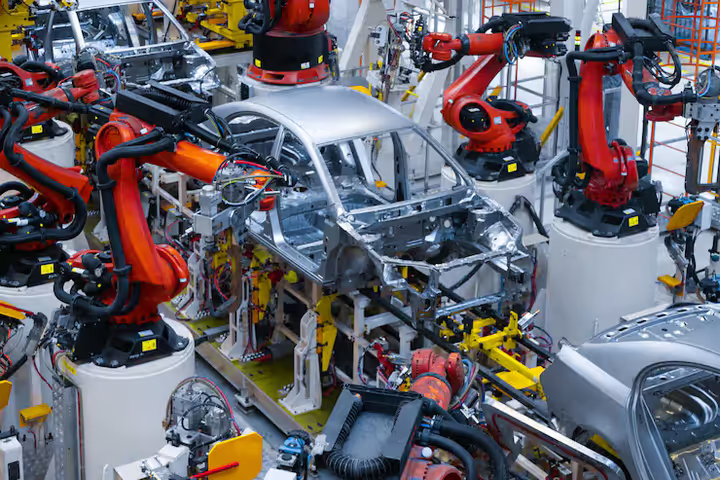
Industrial robots can perform tasks such as welding, assembly, material handling, packaging, painting, and machine tending.
Robotic systems can be integrated with sensors, vision systems, conveyors, and production software.
Variable Frequency Drives
Variable frequency drives, or VFDs, control the speed and torque of electric motors.
They can help match motor operation to process requirements and may contribute to energy-management objectives when correctly selected and configured.
Industrial Networks
Industrial communication networks allow controllers, sensors, machines, and software platforms to exchange information.
Common technologies include Ethernet-based industrial protocols and fieldbus systems.
Applications of Industrial Automation
Industrial automation is used across many industries.
Automotive Manufacturing
Automotive plants use automation for welding, painting, assembly, inspection, material handling, and component production.
Robotic systems can perform repetitive operations while automated inspection systems help monitor manufacturing quality.
Food and Beverage Processing
Automation can control mixing, filling, packaging, temperature, weighing, labeling, and material handling.
Accurate process control can help manufacturers maintain consistent production conditions.
Pharmaceutical Manufacturing
Pharmaceutical facilities use automation for process monitoring, equipment control, packaging, material handling, and data management.
Because pharmaceutical manufacturing can involve strict quality requirements, automation and documentation systems can play an important role in process control.
Chemical Processing
Chemical plants use automated control systems to monitor variables such as temperature, pressure, flow, and chemical concentration.
Automation can help operators manage complex processes and respond to abnormal operating conditions.
Warehousing and Logistics
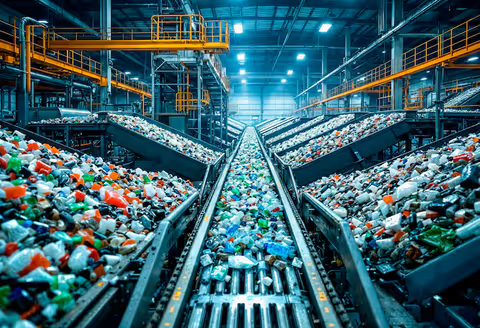
Automated conveyors, robotic systems, barcode scanners, automated storage systems, and warehouse software can coordinate the movement of products and materials.
Industrial Automation and Industry 4.0
Industrial automation is closely connected with the concept of Industry 4.0.
Industry 4.0 describes the development of connected and data-driven industrial environments.
Modern systems may combine:
- Industrial Internet of Things (IIoT)
- Cloud computing
- Edge computing
- Artificial intelligence
- Machine learning
- Digital twins
- Advanced analytics
- Industrial cybersecurity
- Connected robotics
These technologies can enable industrial organizations to collect and analyze operational data in ways that were difficult with older standalone automation systems.
How Industrial IoT Supports Automation
The Industrial Internet of Things connects industrial equipment and sensors to communication and data platforms.
For example, sensors installed on production equipment can collect information about temperature, vibration, energy consumption, or operating cycles.
That information can then be analyzed to identify unusual operating patterns.
Predictive Maintenance
Predictive maintenance uses equipment data and analytical methods to identify potential maintenance requirements before a major failure occurs.
Instead of relying exclusively on fixed maintenance schedules, organizations can use condition information to support maintenance planning.
This can potentially reduce unplanned downtime and improve maintenance resource allocation.
Role of Artificial Intelligence in Industrial Automation
Artificial intelligence is increasingly being incorporated into industrial environments.
AI-based systems can analyze large volumes of operational data and identify patterns that may be difficult to detect manually.
Potential applications include:
- Quality inspection
- Demand forecasting
- Equipment monitoring
- Process optimization
- Anomaly detection
- Production planning
- Energy analysis
- Predictive maintenance
However, AI does not automatically improve every industrial process. Successful implementation depends on reliable data, appropriate models, system integration, cybersecurity, and qualified personnel.
Benefits of Industrial Automation
A well-designed automation system can provide several operational advantages.
Productivity
Automation can support continuous and repeatable production processes, helping organizations increase output where appropriate.
Quality Control
Automated measurement and inspection can provide consistent monitoring of production parameters.
Cost Management
Although automation requires an initial investment, organizations may evaluate it as part of a long-term strategy for labor utilization, downtime reduction, energy management, quality improvement, and production efficiency.
Equipment Monitoring
Connected systems can provide real-time information about equipment status and operating conditions.
Scalability
Modular automation technologies can make it easier to expand or modify certain production processes as requirements change.
Industrial Automation Costs
The cost of an automation project can vary significantly.
Important factors include:
- Machine type
- Production volume
- Number of automated operations
- Robot requirements
- Sensors and instrumentation
- PLC and control hardware
- Software
- System integration
- Installation
- Employee training
- Maintenance requirements
- Cybersecurity
- Facility modifications
A simple machine-control project may require a relatively modest investment, while a fully integrated manufacturing system can involve substantial capital expenditure.
Businesses should evaluate the total cost of ownership rather than looking only at the initial equipment price.
Return on Investment in Automation
Return on investment (ROI) is an important consideration when evaluating automation projects.
A basic assessment may compare the project investment with potential financial benefits such as:
- Increased production
- Reduced downtime
- Lower material waste
- Improved quality
- Reduced maintenance costs
- Better energy efficiency
- Improved asset utilization
However, financial calculations should account for installation costs, maintenance, software licenses, training, upgrades, and equipment replacement.
Industrial Automation and Energy Efficiency
Energy management is becoming an important consideration for industrial organizations.
Automation systems can monitor electricity consumption and identify operating patterns.
For example, facilities may use automated controls to manage motors, pumps, compressors, HVAC equipment, and production schedules.
Energy data can help organizations identify equipment that consumes more energy than expected and investigate opportunities for improvement.
Industrial Automation Cybersecurity
As industrial systems become more connected, cybersecurity becomes increasingly important.
Traditional industrial networks were often designed primarily around reliability and availability. Modern connected systems may also need protection against unauthorized access and cyber threats.
Organizations can improve security by implementing measures such as:
Network Segmentation
Separating critical industrial networks from other networks can help limit the impact of security incidents.
Access Management
User accounts should have appropriate permissions based on job responsibilities.
Software Updates
Organizations should maintain appropriate patching and update processes while considering the operational requirements of industrial equipment.
Monitoring
Security and operational monitoring can help identify unusual network or equipment behavior.
Challenges of Industrial Automation
Automation offers many potential benefits, but implementation also presents challenges.
High Initial Investment
Equipment, software, integration, installation, and training can require significant capital.
Integration Complexity
Connecting new automation equipment with older machinery can be technically challenging.
Skilled Workforce Requirements
Automation systems require engineers, technicians, operators, programmers, and maintenance professionals with appropriate technical skills.
Maintenance
Automated equipment still requires preventive maintenance, calibration, software management, spare parts, and technical support.
Cybersecurity Risks
Greater connectivity can introduce additional cybersecurity considerations that must be addressed during system design.
How to Plan an Industrial Automation Project
A structured approach can reduce implementation risks.
Step 1: Define the Process
Identify the production process, current problems, bottlenecks, quality issues, and safety requirements.
Step 2: Establish Objectives
Set measurable objectives for productivity, quality, downtime, energy use, safety, or other relevant performance indicators.
Step 3: Evaluate Technology
Compare suitable PLCs, robots, sensors, drives, software, communication systems, and other components.
Step 4: Calculate Total Costs
Consider equipment, integration, installation, training, maintenance, software, and future upgrades.
Step 5: Test the System
Testing should verify that equipment, software, safety functions, and communication systems operate as intended.
Step 6: Train Employees
Operators and maintenance personnel should understand normal operation, alarms, troubleshooting procedures, and safety requirements.
Step 7: Monitor Performance
After implementation, organizations can measure actual results against the original objectives and identify opportunities for further improvement.
Future Trends in Industrial Automation
The industrial automation sector is expected to continue evolving as connected technologies become more capable.
AI-Enabled Manufacturing
Artificial intelligence can support advanced inspection, predictive analytics, production planning, and process optimization.
Collaborative Robots
Collaborative robots, commonly known as cobots, are designed for applications where robots and people may work in closer proximity under appropriate safety conditions.
Digital Twins
Digital twins create digital representations of physical assets or processes. Organizations can use these models for simulation, analysis, monitoring, and optimization.
Edge Computing
Edge computing processes data closer to industrial equipment instead of sending every data point to a remote system.
This can be useful for applications requiring rapid data processing or local decision-making.
Smart Factories
Smart factories combine automation, connectivity, analytics, software, and industrial equipment to create more integrated production environments.
Frequently Asked Questions
What is industrial automation?
Industrial automation is the use of control systems, software, sensors, robotics, and industrial equipment to operate processes with reduced manual intervention.
What is an example of industrial automation?
An automated packaging line is a common example. Sensors can detect products, controllers can coordinate equipment, and machines can fill, seal, label, and move packages with limited manual intervention.
Is industrial automation expensive?
Costs vary depending on the complexity of the project. A small machine-control system and a fully automated factory have very different investment requirements.
Does industrial automation replace workers?
Automation can change the type of work people perform rather than simply eliminating all human involvement. Workers may increasingly focus on equipment supervision, programming, maintenance, quality management, engineering, and process improvement.
What technologies are used in industrial automation?
Common technologies include PLCs, HMIs, sensors, robotics, VFDs, SCADA, industrial networks, machine vision, IIoT, analytics, and industrial software.
Conclusion
Industrial automation is an important part of modern manufacturing and industrial operations. From PLC-based machine control to robotics, IIoT, artificial intelligence, and smart factories, automation technologies are helping organizations improve process visibility, consistency, productivity, and operational decision-making.
For businesses considering automation, the most effective approach is not simply to automate as many tasks as possible. Instead, organizations should identify specific operational problems, evaluate the available technologies, calculate total costs, address cybersecurity and safety requirements, and measure results over time.
As connected technologies and industrial software continue to develop, industrial automation is likely to remain a major area of investment and innovation across manufacturing, logistics, energy, processing, and other industrial sectors.